
Flathead Lake: Trophic Cascade
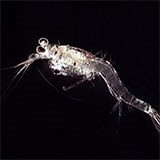
At the same time, populations of nonnative lake trout and lake whitefish, which were themselves an introduced species, exploded with Mysis shrimp as a food source. With the increase in both Mysis shrimp and lake trout, native bull and cutthroat trout populations have dramatically declined, and Flathead Lake’s fish community is now dominated by nonnative species. Additionally, as Mysis shrimp consume native zooplankton which eat algae, the amount of algae in Flathead Lake has increased.
Therefore, the introduction of Mysis shrimp not only influenced the biological community of Flathead Lake but also directly affected the lake’s water quality.
FLBS researchers were among the first to empirically document this Trophic Cascade in a lake ecosystem, and they continue to track the ongoing ecological effects.
- Spencer, C. N., B. R. McClelland and J. A. Stanford. 1991. Shrimp stocking, salmon collapse and eagle displacement: Cascading interactions in the food web of a large aquatic ecosystem. BioScience 41(1):14–21.
- Stafford, C. P., J. A. Stanford, F. R. Hauer and E. B. Brothers. 2002. Changes in lake trout growth associated with mysis relicta establishment: A retrospective analysis using otoliths. Transactions of the American Fisheries Society 131(5):994–1003.
- Ellis, B. K., J. A. Stanford, D. Goodman, C. P. Stafford, D. L. Gustafson, D. A. Beauchamp, D. W. Chess, J. A. Craft, M. A. Deleray and B. S. Hansen. 2011. Long-term effects of a trophic cascade in a large lake ecosystem. Proceedings of the National Academy of Sciences USA 108(3):1070–1075. Full text