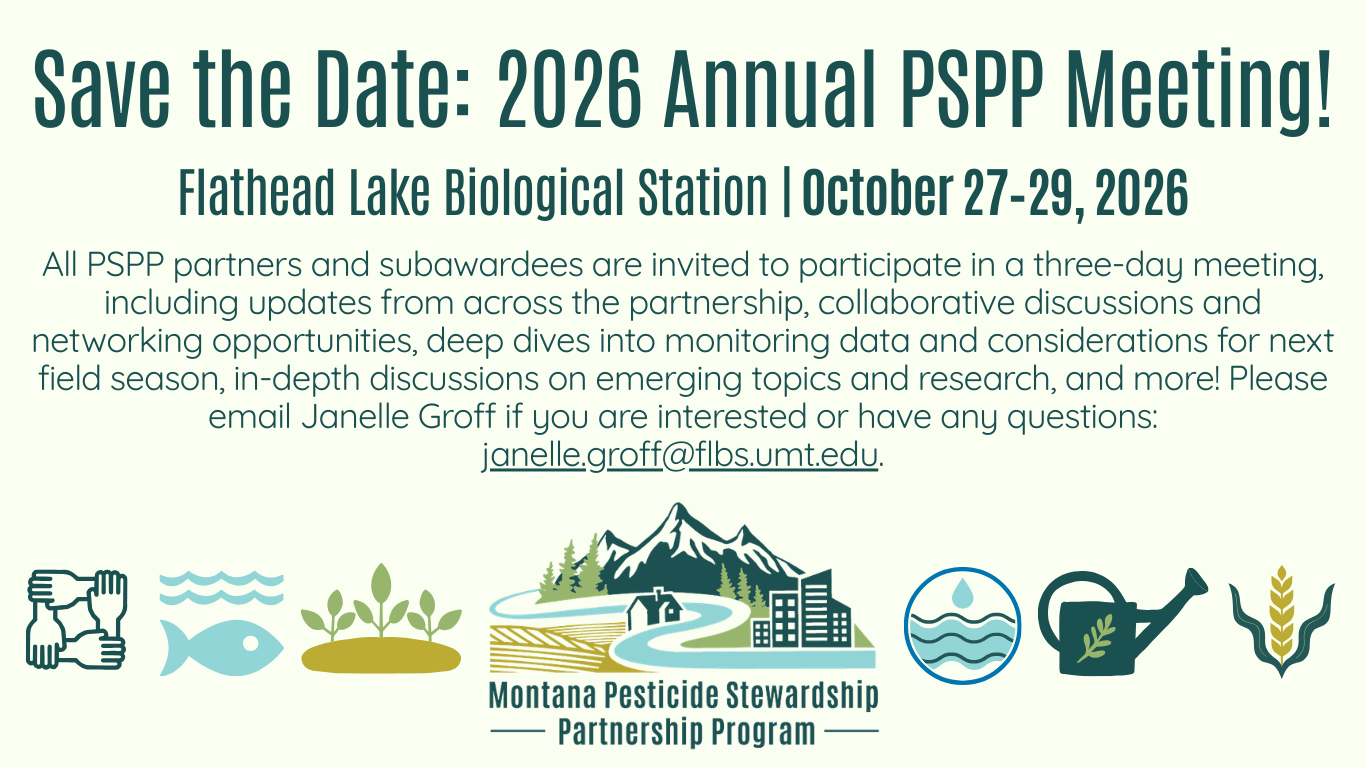
At the end of October, the PSPP hosted their 2025 Annual Meeting at the Flathead Lake Biological Station to share program updates, connect with partners and subawardees, and discuss strategies to fill gaps in outreach and monitoring in 2026. Below are some highlights from the meeting:
Day 1: October 28 – Welcome & Public Seminar
The conference kicked off with a program overview by Dr. Rachel Malison, who introduced the PSPP team and advisory board, and provided an overview of EPA funding and priorities.
A handful of PSPP subaward recipients shared exciting updates about their respective projects, including:
- City of Missoula's Takima Park Stormwater Bioretention Basin
- Montana Watershed Coordination Council (MWCC)'s Education and Outreach efforts, as well as the 2026 CRB Watershed Tour
- Montana Department of Agriculture (MDA)'s Groundwater Protection, Pesticide Waste Disposal and Pesticide Container Recycling Programs
- Montana State University Extension's Pesticide Leaching Potential in Irrigated Agriculture Study
The day wrapped up with a dinner and public seminar including Surface Water Monitoring Highlights, Community Action Tips & Resources, and Q&A with the PSPP Team.
Day 2: October 29 – Collaboration & Deep Dives
The second day kicked off with a welcome back as well as introductions and re-introductions of attendees, followed by more exciting updates by PSPP subaward recipients about their respective projects, including:
- Kootenai Tribe of Idaho (KTOI)'s Pesticide Inventory in the Kootenai River
- Confederated Salish & Kootenai Tribes (CSKT)'s Fish Tissue Sampling and other Monitoring Efforts
- Montana Department of Environmental Quality (DEQ)'s Permits, Subawards, and Education and Outreach Efforts
Following subaward updates, Montana State University's Dr. Cecil Tharp (MSU Pesticide Education Program) shared the results from Pesticide Use Surveys, followed by a discussion about high risk behaviors, implications, and possible mitigation strategies.
After lunch, the PSPP team shared a "deep dive" into the 2025 Monitoring Plan, including lessons learned, data summaries and trends, and technical discussion. The team then shared ideas for the 2026 Monitoring Plan, opening the floor to partner feedback and considerations. Discussion surrounded goals of reducing drive time and engaging more volunteers via "subbasin", "regional", and longitudinal sampling site selection frameworks.
The day wrapped up with dinner and drinks, as well as a Pesticide + Water Quality Trivia Night!
Day 3: October 30 – Outreach & Network Building
The final day kicked off with a discussion about PSPP Outreach Goals and Key Messages, Ongoing Projects, as as well as a recap of Events, Audiences, & Materials from 2025. The floor was opened for partner feedback, with discussion surrounding program language, as well as online and audience-specific resources. Breakout groups worked to brainstorm new outreach strategies for major stakeholder groups.
Montana Watershed Coordination Council's Amy Seaman gave an in-depth introduction to the 2026 Colombia River Basin Watershed Tour. The tour will aim to highlight the work of PSPP and other local watershed groups in the CRB. Attendees participated in discussion surrounding logistics and engagement for this event.
The conference wrapped up with lunch and additional opportunities for networking.
We are grateful to everyone who attended and contributed to the success of this conference. Your insights and collaboration are invaluable as we continue to advance the PSPP.