
Learning by Doing at FLBS

Beyond Textbooks: Learning By Doing at Flathead Lake Biological Station
By 2026 Ted Smith Environmental Storytelling Intern Vivianne Ostheimer
The sound of a tent unzipping marks the start of a mid-June morning at a campground outside East Glacier. Bird song and the steady rush of the Two Medicine River spilling from its lower reservoir fill the air. Nineteen-year-olds and twentysomethings trickle slowly from their tents, pajama pants still on and bear sprays in hand. They congregate near a camp stove tended by an early-riser and wait for cold breakfast burritos to warm.
Needless to say, this is not your typical college class.
Conservation Biology, taught by Gordon Luikart, is one of eight Summer Session courses offered at the Flathead Lake Biological Station. This summer, 55 students from 26 universities are taking one or more of those two- to four-week courses. All are focused on helping students learn about ecology by getting their hands – and waders – dirty in the field.

"There's so much that's not in textbooks," Luikart said. "And you can't learn it unless you talk to an on-the-ground scientist or conservation biologist or wildlife manager."
Yesterday, these students slogged through the Two Medicine Valley, waist-deep in muddy water, hoping to catch frogs and toads. They learned about chytrid, an invisible and deadly fungus infecting amphibians worldwide. A young bull moose watched them from a distance, eventually plunging into the pond and scattering the students back toward the trail.
Today, they’re headed back to the park to electrofish with Glacier National Park biologists. As the professionals hike upstream and send electric currents into the water — temporarily stunning the fish and causing them to float to the surface — the students will follow behind to catch the fish in nets to identify, tag and then release them. Afterwards, the students will hike up Lunch Creek and throw snowballs at each other on their way to search for stoneflies in a glacial stream. The day will end with a visit to Logan Pass and dinner (burritos again) with a view.
“There’s not much like it on earth,” Luikart said.
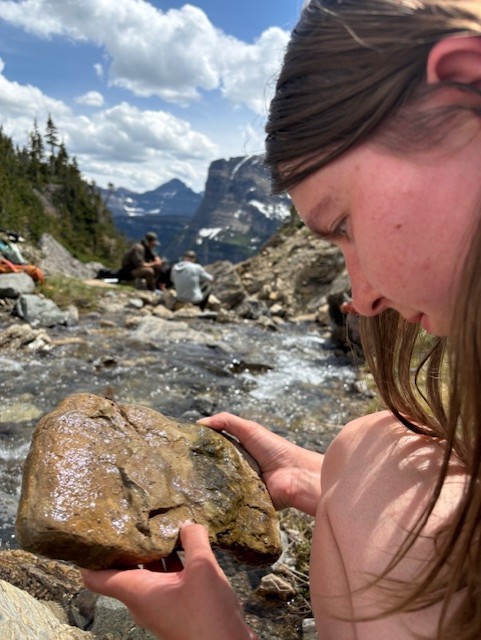
Caption: University of Montana senior Zoe Chamberlin searches for stoneflies at Lunch Creek. Credit: Vivianne Ostheimer
Luikart, a geneticist and ecologist, has taught Conservation Biology for a decade, using almost the same format each summer.
Students earn three college credits in just two weeks. Out of 10 class days, they spend seven in the field: six in Glacier and one at the CSKT Bison Range. On these trips, Luikart connects students with experts from the Blackfeet Nation and several state and federal agencies: Montana Fish, Wildlife & Parks, the United States Geological Survey (USGS) and the National Parks Service.
The class doesn't just meet experts— students work alongside them. On the first day, Luikart reads a quote from Chinese philosopher Confucius: "Tell me and I will forget, show me and I may remember, involve me and I will understand."
It wasn't long before Maggie Buseman, one of seven students in his class, found herself living those words.
Her boots sank into the mud and water sloshed against her waders as she dodged dense schools of tadpoles, looking for larger signs of movement in a Two Medicine swamp. When students caught an amphibian, they identified it using physical characteristics before learning how to swab it for chytrid.
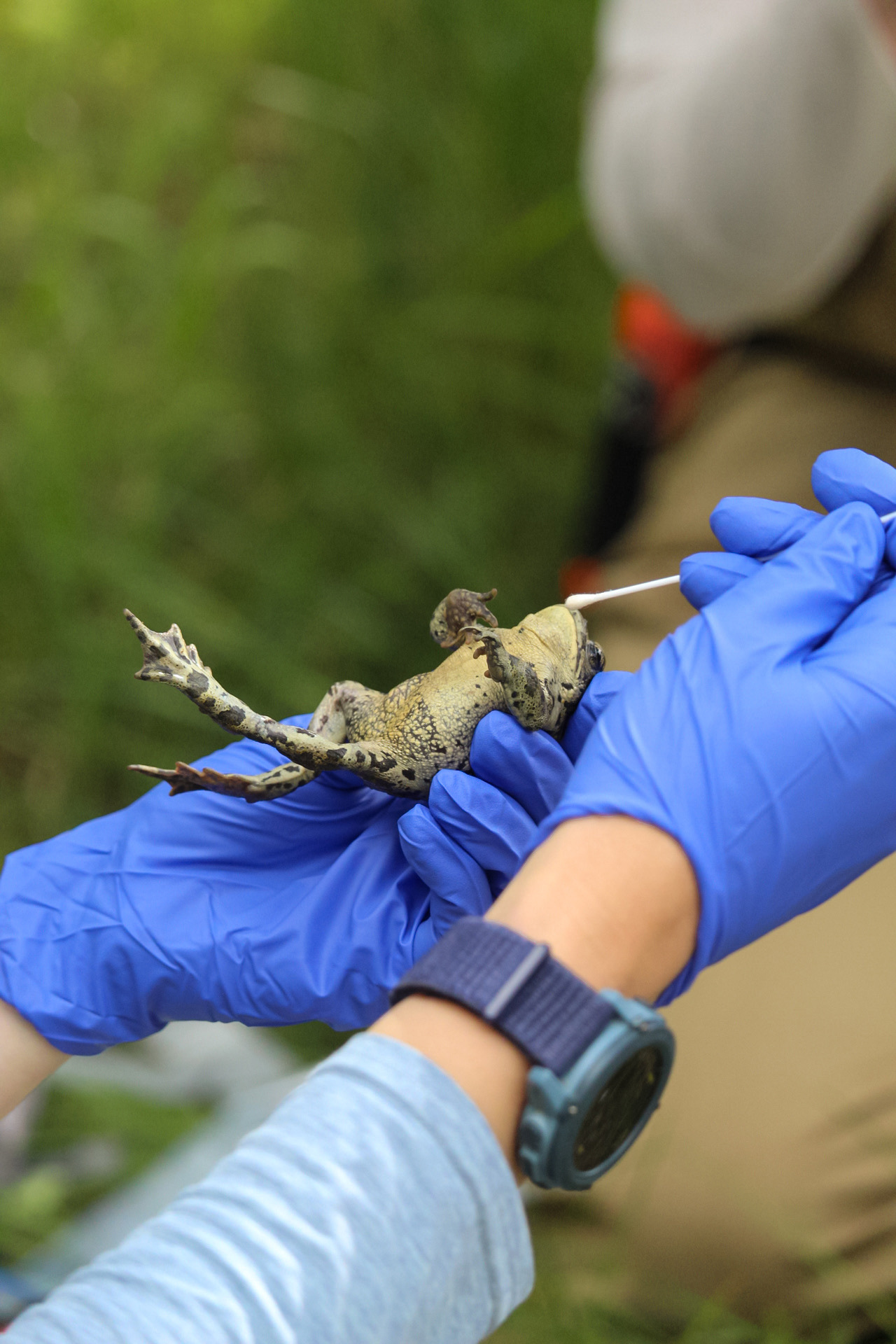
Caption: An amphibian expert swabs a boreal toad, demonstrating chytrid-fungus testing for the students. Credit: Emily Salmonsen
“I'm dyslexic, and so I feel like actually going and learning those things with my hands registers so much better than reading a textbook,” she said. “That works for me.”
Buseman, a 19-year-old from Rockford, Iowa, heard about the bio station from her college advisor at Iowa State University. She applied to the program and received a scholarship.
“This is perfect,” Buseman said. “I can get 13 credits done for a fraction of the cost that I would at Iowa State.”
In addition to Conservation Biology, the environmental-science major is taking Aquatic Microbial Ecology, Alpine Ecology, and Forest & Fire Ecology.
“I’m most excited for Aquatic, just because I hope to go into water restoration,” Buseman said. “That’s something I’m really passionate about, because I come here and I can drink out of the tap.” At home in Iowa, that’s not true for her.
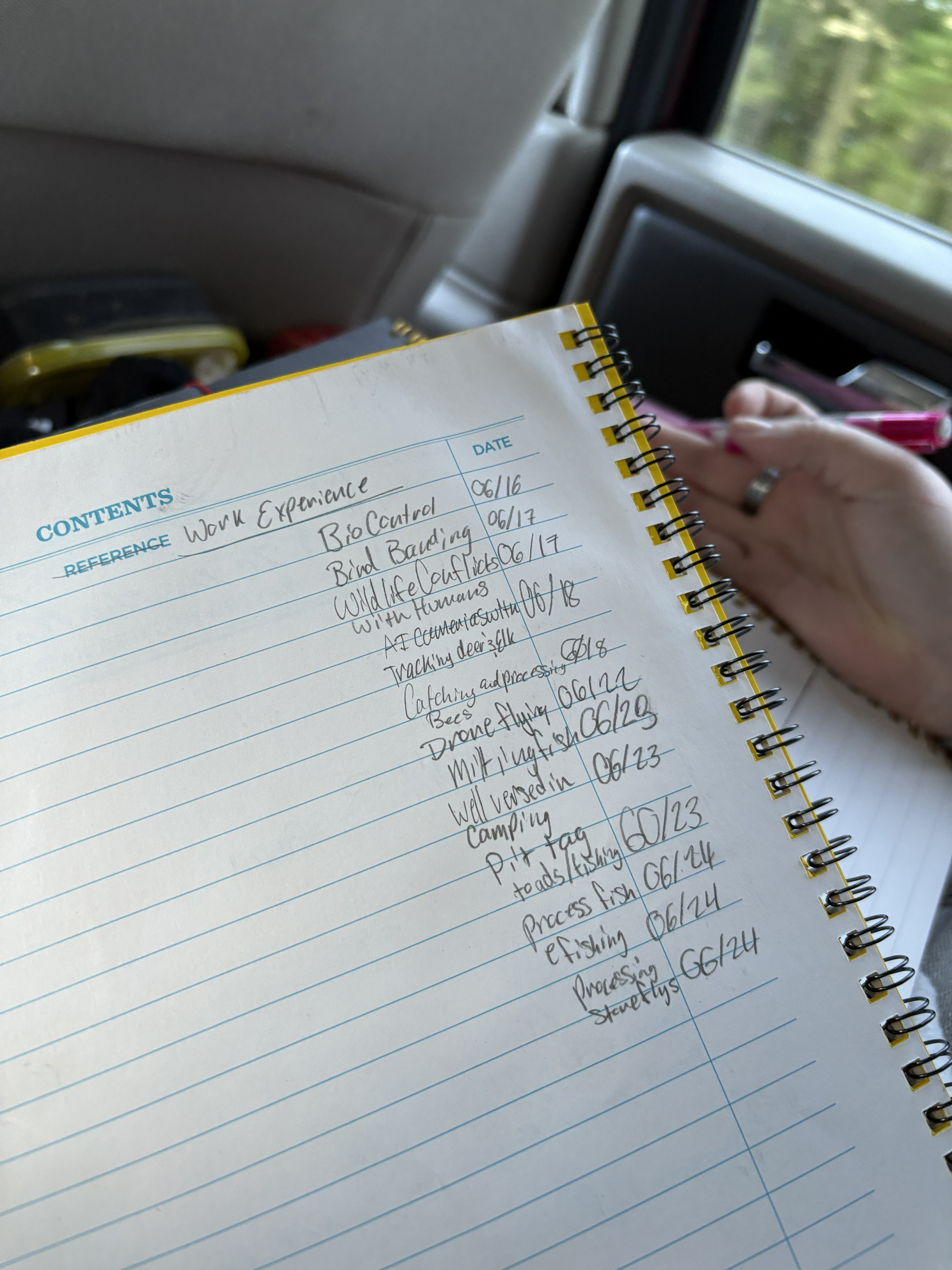
Caption: Buseman shows off a page in her journal where she’s keeping a running list of the ‘work experience’ she’s gained in Conservation Biology. Credit: Vivianne Ostheimer
Even before Conservation Biology student Shelby Hatz applied to the University of Montana, she was planning to spend at least one summer in Montana taking classes at the bio station.
“I was pretty immediately obsessed,” the 19-year-old sophomore from Bailey, Colorado, said.
“It's been a goal for a long time, and I’m glad I followed through.”
As another environmental science student, Hatz said she values and seeks out field courses.
“I don't absorb the information as well if I can't actually carry it out or watch it be done,” she said.
Taking Luikart’s course helped her understand more about the complicated and intertwined ecological and societal problems she will have to address in any conservation-focused career.
“General takeaways from the class so far? I’m sure Gordon would be proud to hear me say ‘the complexities of conservation biology,’” Hatz said with a smile.
Luikart returned to a central message over and over throughout the course: conserving biodiversity and natural resources is complicated.
“Politics has always been there,” Luikart said. “It's more of an issue in recent years. Funding's also more of an issue in recent years.”
But by getting students outside to talk with conservation biology experts and practice skills in the field, Luikart aims to cultivate and strengthen their connections to organisms and places.
“People won’t conserve something they don’t love, and you can't love something unless you know about it,” Luikart said.
And, according to Luikart, you can’t know about something, really, unless you do an experiential-learning course. He says that every summer, he watches students light up as they interact with the environment and organisms around them.
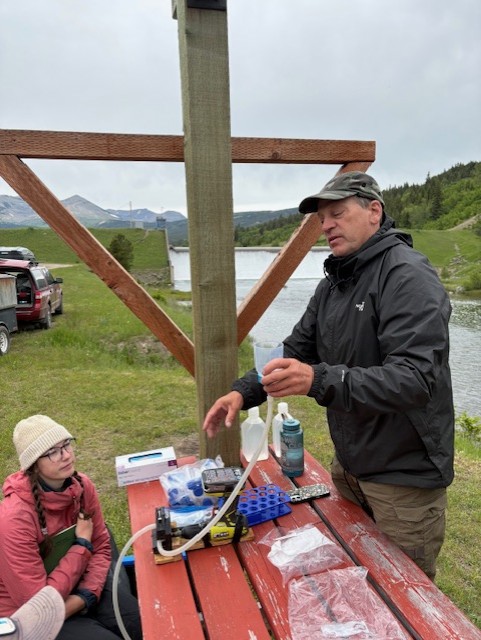
Caption: Luikart (right) explains the process of collecting environmental DNA, or e-DNA, to student Shelby Hatz. E-DNA comes from living organisms (like skin or feces, for example), and can be important for early detection of invasive species.
The longer he’s taught this course, the more often he encounters students who he says are uncomfortable being outside.
"It's exposing more people to stuff they've never been exposed to,” Luikart said. “People who’ve never gone camping, they go camping. And it can be life-changing for them. Some of them learn that they don’t like field work. Some of them learn that they love it.”
If Luikart had his way, outdoor education would start long before college. He says teachers should be more supported — with funding, respect and encouragement — to teach field courses and take students on field trips.
“Our society needs more people outdoors,” he said.
To learn more about the Flathead Biological Station’s summer courses and year-round programs, visit the FLBS Summer Program website.