
FLARE K-12 Welcomes Soft Landing Missoula

From Plankton to Place: Soft Landing Missoula Kids Visit Flathead Lake Biological Station
By 2026 FLBS Ted Smith Environmental Storytelling Intern Vivianne Osthmeimer
Kelly Minear, the bio station’s education coordinator, reminded the children to keep the net just under the surface of the water — but not too deep. Plankton need light, but they can get sunburns, she said. Just like us.
The kids visited the bio station with Soft Landing Missoula’s “Science Outdoors” summer program on July 22. Soft Landing is a local nonprofit that supports refugee and immigrant families through youth programs, mentorship and community-building activities.
Back in the classroom, Minear placed the samples under a microscope. Tiny translucent creatures pulsed and spun on the slide.
“Does anyone know why they’re clear?” Minear asked. The kids scrunched their brows, thinking. “To avoid predators,” she explained.
“Like sharks!” someone yelled excitedly.
Minear laughed. “There are no sharks in Flathead Lake … but maybe you’ll get to change that later if you play sharks and minnows!”
She put a new sample under the microscope, and a recognizable shape appeared on the screen.
“That’s a shrimp!” everyone shouted.
They were right; it was a mysis shrimp, an introduced species that feeds invasive lake trout. Bio station researchers regularly sample and monitor mysis as part of their mission to understand, improve and communicate the state of Flathead Lake.
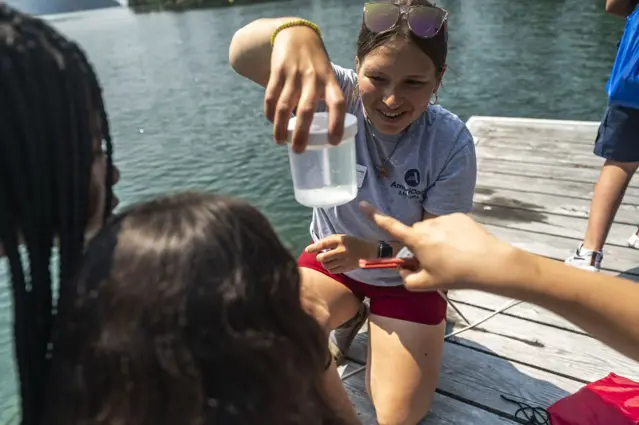
Alyssa Schaefer leads children in a water testing science experiment at the Flathead Lake Biological Station on Wednesday, July 22 at Flathead Lake. SHANNA MADISON, Missoulian
After viewing their samples, the kids created their own plankton from pipe cleaners, popsicle sticks and washers before facing off to see whose creation could stay suspended just below the water's surface without sinking or floating to the top.
Narmene, a fifth-grade Science Outdoors participant, says she changed her mind about science this summer. From learning about chemistry by creating a baking soda and vinegar “volcano” to learning about fire ecology in the Rattlesnake National Recreation Area, she’s gone from bored to excited.
“In school, science is so boring. You just sit there, and nothing makes sense,” Narmene said. “This is like activities and stuff! I like it way more.”
Narmene cheered as two of her friends dropped their “plankton” into clear tubs of water. One sank quickly, and the other floated. The kids groaned — back to the drawing board.
Natalia Boise, Soft Landing’s youth program manager, judged the plankton competition, promising ice cream and a propeller hat for the most successful and the “cutest” phytoplankton. After their science lessons and activities, Boise took the kids to swim in Flathead Lake.
“Something that's important to us is introducing these new neighbors to the place that they're now calling home by experiencing Montana's nature,” she said. “I think that that's especially important for Montana identity.”
Besides summer and year-round youth programs, Soft Landing provides a community center for resources and gatherings and directs a program called United We Eat, where immigrant and refugee chefs prepare takeout meals for purchase by Missoulians.
Boise was Soft Landing’s first intern in 2017. Now, in her sixth year of working with the nonprofit, its youth program has grown from 25 kids to 170.
”I just really love working with youth, and it's an added bonus working with youth from different countries,” Boise said. “They teach me so much.”
For Boise, introducing immigrant and refugee kids to Flathead Lake is part of helping them feel at home in Montana.
For Minear and the bio station, it's also about educating the next generation of Montanans on the importance of protecting the health of their state’s largest freshwater ecosystem.
“Even if they're not interested in science,” Minear said, “we need people to take care of the lake. So that's the hope — to create future stewards.”
This story originally appeared in the Missoulian on July 25, 2026.