
2025 State of the Lake

Since 1977, the Flathead Monitoring Program at the Flathead Lake Biological Station has used standardized scientific methods to collect fundamental physical, chemical, and biological data on Flathead Lake and its main inflows. To assess water quality, monitored variables include water clarity, abundance of planktonic algae, oxygen levels in the lake’s bottom waters, and the supply of key nutrients, especially phosphorus (P), that can drive increases in algae that degrade water clarity and deplete deep water oxygen. Sampling occurs year-round at Midlake Deep, a fixed site near the Bio Station at the lake’s deepest point. Data are shown for summer months when sampling is more frequent.
The state of Flathead Lake in 2025 continues to be excellent. We see no consistent signs of long-term or even recent deterioration of the lake’s world-class water quality. This sustained status of exceptional water supports the value of the continued efforts by our community to protect the Flathead Watershed and to reduce nutrient inputs via wastewater treatment and other measures.
Water Clarity
The clarity of the lake is measured using a Secchi disk, which is lowered into the water until it is no longer visible. After the lake’s spring inflow of turbid river water has ended, clarity can reflect the abundance of planktonic algae suspended in the water. Deeper measurements (larger numbers) indicate clearer water. Secchi depths decline when a lake becomes more polluted.
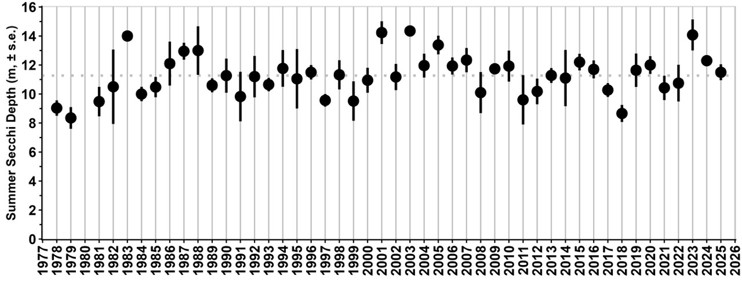
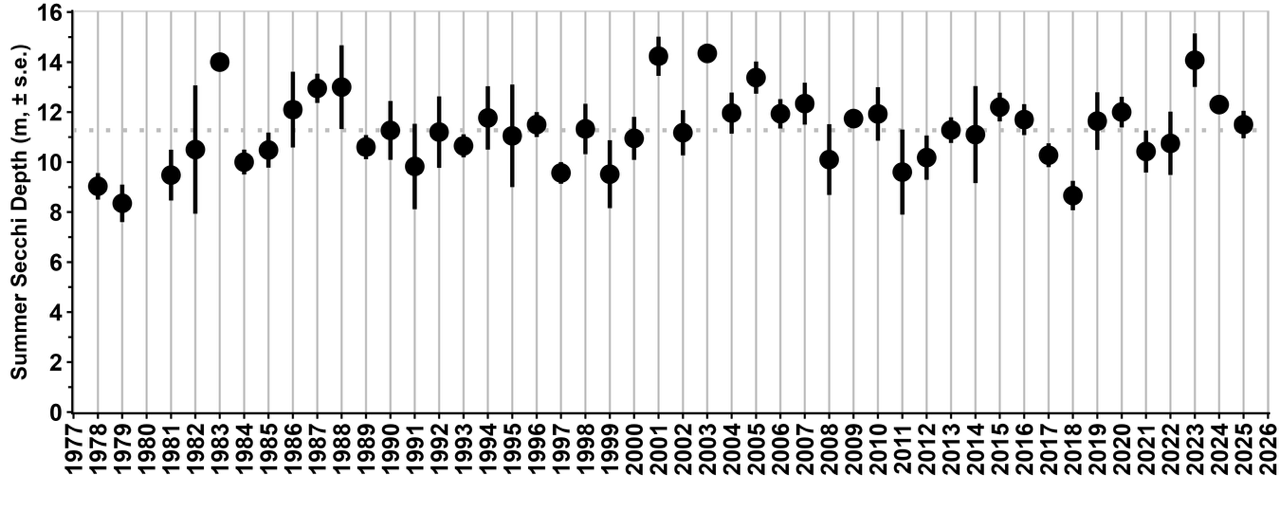
Flathead Lake water clarity continues to be very high, typical of a highly oligotrophic (unproductive) lake. 2025 data fall very close to the long-term average of 11.2 m. While within-year (seasonal) and inter-annual variations occur, there is no long-term statistical trend. The dotted line indicates the long-term average. Data for 1978-2025 (July, Aug, Sept).
Planktonic Algae
The abundance of planktonic algae in lake water is quantified by measuring concentrations of chlorophyll, a photosynthetic pigment carried by all algae and cyanobacteria. Clearer lakes have lower amounts of chlorophyll, where as more productive lakes are greener with higher chlorophyll concentrations.
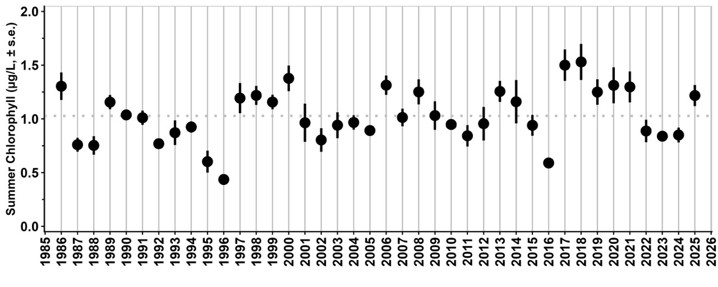
Chlorophyll concentrations in Flathead Lake continue to be low and indicative of its highly oligotrophic (nutrient-poor) status and consistent with the lake’s impressive clarity. We see no statistical trend over the observation period. Concentrations in 2025 ( ̴ 1.2 ug/L) were somewhat higher than the long-term average (1.04 ug/L) but within the range of previous observations. The dotted line indicates the long-term average. Data for 1986-2025 (July, Aug, Sept).
Dissolved Oxygen
The concentration of oxygen in deep waters is expressed as a percentage of the maximum oxygen concentration that water can hold at that temperature. Oxygen is measured in situ using a submersible sensor. High values are good for aquatic organisms and are common in most of Western Montana. Low values can indicate water quality deterioration due to decomposition of sinking algae.
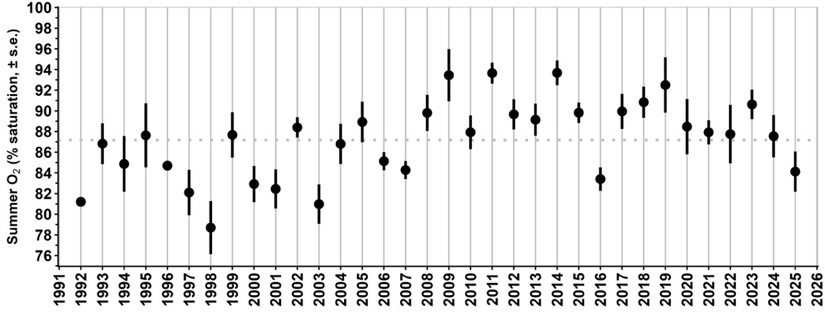
Deep-water oxygen concentrations in Flathead Lake are high, typical of high-quality oligotrophic waters. A statistical increase in deep-water oxygen concentration has occurred in the lake since observations began in 1992. This trend is favorable and suggestive of decreasing inputs of organic matter to bottom waters and thus less oxygen consumption. Oxygen levels in 2025 ( ̴ 83%) were lower than the long-term mean (87.2%) and lower than generally seen since 2008. The dotted line indicates the long-term average. Data for 1992-2025 (July, Aug, Sept; Sept only in 1992 and 1996).
Phosphorus (P) Nutrient
The total concentration of all forms of phosphorus (P) present in lake waters is quantified by laboratory colorimetric analysis at FLBS. High concentrations of P can support undesirable algal blooms that degrade water clarity, can be toxic, and whose decomposition can deplete deep water oxygen levels. Many lakes in the U.S. are seeing increases in P due to inputs from various human activities, including losses from wastewater, animal husbandry, and agricultural fertilizer use.
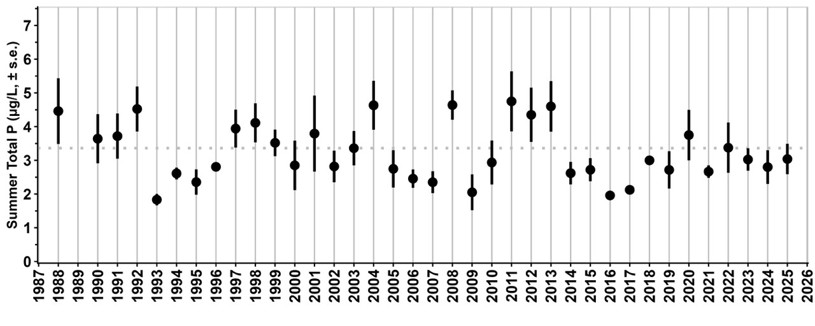
Concentrations of total P (TP) in Flathead Lake continue to be very low, typical of the lake’s oligotrophic status, and have no long-term statistical trend. This constancy is encouraging, as P is the most important nutrient that limits algae growth in Flathead Lake. TP concentration in 2025 (2.9 ug/L) was lower than the long-term average (3.3 ug/L) but consistent with observations since 2014. The dotted line indicates the long-term average. Data for 1988-2025 (July, Aug, Sept).
Mysis Shrimp
Mysis is a non-native crustacean that found its way to Flathead Lake after it was introduced to several upstream lakes. Its proliferation was responsible for the collapse of the Flathead Lake kokanee salmon fishery in the mid-1980s. Summertime lakewide abundances of Mysis are estimated from night-time vertical net tows.
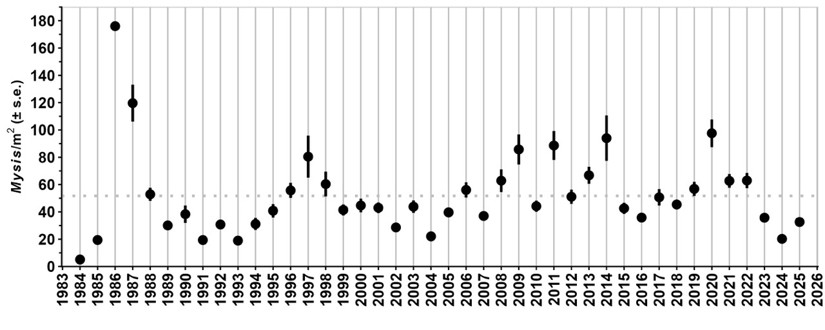
The Mysis population shows evidence of four ~10-year cycles with some indication of a slow long-term increase. Population levels in 2025 were somewhat higher than 2024, suggesting the beginning of a new 10-year cycle. The dotted line indicates the long-term average. Data for 1984, 1985, and 1986 from S. Rumsey (1988 progress report F-7-R-37, Inventory of waters of the project area. MT Dept of Fish, Wildlife, and Parks)
View the 2025 State of the Lake PDF
The FLBS Flathead Monitoring Program is made possible through a blend of state support, grant funding, and philanthropic giving. Learn more about how you can make an impact for the future of our waters.