
Life History Energy Balance of Organisms
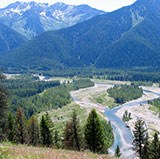
Most aquatic organisms are "cold blooded" (ectotherms), meaning that their body temperature, metabolism, and ecological activity are determined by the temperature of their surrounding environment. Therefore water temperature is one of the most important determinants of occurrence, growth, reproduction, survival, and all around success for aquatic organisms (e.g. insects, frogs, and fish).
FLBS research has shown that water temperature drives biological patterns observed on the landscape. For example, aquatic insects and other organisms are distributed predictably along stream corridors from headwaters to piedmont valleys in relation to temperature patterns. On floodplains, thermal characteristics of different habitat types throughout the year determine which aquatic organisms are able to thrive (or just survive) in which locations during different life history stages.
These discoveries about life history energy balance of organisms in montane environments have important ramifications for predicting the consequences of climate change.
- Ward, J. V. and J. A. Stanford. 1982. Thermal responses in the evolutionary ecology of aquatic insects. Annual Review of Entomology 27:97–117.
- Hall, C. A. S., J. A. Stanford and F. R. Hauer. 1992. The distribution and abundance of organisms as a consequence of energy balances along multiple environmental gradients. Oikos 65(3):377–390.
- Lowe, W. H. and F. R. Hauer. 1999. Ecology of two large, net-spinning caddisfly species in a mountain stream: distribution, abundance and metabolic response to a thermal gradient. Canadian Journal of Zoology 77:1637–1644
- Wu, H., J. S. Kimball, M. M. Elsner, N. Mantua, R. F. Adler and J. A. Stanford. 2012. Projected climate change impacts on the hydrology and temperature of Pacific Northwest rivers. Water Resources Research 48:W11530.
- Muhlfeld, C. C., R. P. Kovach, L. A. Jones, R. Al-Chokhachy, M. C. Boyer, R. F. Leary, W. H. Lowe, G. Luikart and F. W. Allendorf. 2014. Invasive hybridization in a threatened species is accelerated by climate change. Nature Climate Change 4:620–624.
- Giersch, J. J., S. Jordan, G. Luikart, L. A. Jones, F. R. Hauer and C. C. Muhlfeld. 2015. Climate-induced range contraction of a rare alpine aquatic invertebrate. Freshwater Science 34(1):000–000.
- Stanford, J. A., M. L. Anderson, B. L. Reid, S. D. Chilcote, and T. S. Bansak. In press. Thermal diversity and the phenology of floodplain aquatic biota. In: D. Gilvear, M. Greenwood, M. Thoms, and P. Wood, editors. River Science: Research and Applications for the 21st Century. Wiley.