
Landscape Ecology of Pacific Salmon
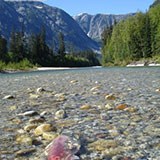
FLBS in cooperation with other organizations documented salmonid biodiversity and productivity of a suite of pristine Pacific salmon river ecosystems observatories. The research focused on salmonid habitat requirements that appeared to vary with life history stage and population structure. We believed that productivity of habitat is controlled by non-linear biophysical processes that create and maintain a dynamic or constantly Shifting Habitat Mosaic (SHM). Our research also addressed how salmon rivers and their stocks respond to climate change. Runoff and temperature patterns are primary determinants of physical habitat in rivers and therefore critically influence salmon productivity. Since both variables may be changed significantly by climate warming, better resolution of climate effects was needed to produce robust conservation strategies for salmon and salmon related biodiversity. Human activities tend to reduce or dampen the variable nature of rivers in ways that should be predictable and, therefore, correctable given a robust understanding and modeling of salmon productivity and population dynamics in the context of the SHM concept.
Read more about the SaRON project (link on old site)
- Savvaitova, K. A., K. V. Kuzishchin, M. A. Gruzdeva, D. S. Pavlov, J. A. Stanford and B. K. Ellis. 2003. Long-term and short-term variation in the population structure of Kamchatka steelhead Parasalmo mykiss from rivers of western Kamchatka. Journal of Ichthyology 43(9):757–768.
- McPhee, M. V., F. Utter, J. A. Stanford, K. V. Kuzishchin, K. A. Savvaitova, D. S. Pavlov and F. W. Allendorf. 2007. Population structure and partial anadromy in Oncorhynchus mykiss from Kamchatka: relevance for conservation strategies around the Pacific Rim. Ecology of Freshwater Fishes 16(4):539–547.
- McPhee, M. V., T. H. Tappenbeck, D. C. Whited and J. A. Stanford. 2009. Genetic diversity and population structure in the Kuskokwim River drainage support the 'recurrent evolution' hypothesis for sockeye salmon life histories. Transactions of the American Fisheries Society (138):1481–1489.
- Pavlov, D. S., K. A. Savvaitova, K. V. Kuzishchin, M. A. Gruzdeva and J. A. Stanford. 2009. The Status and Monitoring of the Salmonid Biodiversity and Their Environment on Kamchatka (on the Territory of the "River Kol" Protected Area). KMK Scientific Press, Moscow.
- Hill, A. C., T. S. Bansak, B. K. Ellis and J. A. Stanford. 2010. Merits and limits of ecosystem protection for conserving wild salmon in a northern coastal British Columbia river. Ecology and Society 15(2):20 [online] URL: http://www.ecologyandsociety.org/vol15/iss2/art20/.
- Eberle, L. C. and J. A. Stanford. 2010. Importance and seasonal availability of terrestrial invertebrates as prey for juvenile salmonids in floodplain spring brooks of the Kol River (Kamchatka, Russian Federation). River Research and Applications 26:682–694.
- Morris, M. R. and J. A. Stanford. 2011. Floodplain succession and soil nitrogen accumulation on a salmon river in southwestern Kamchatka. Ecological Monographs 81(1):43–61.
- Price, M. H. H., A. G. J. Rosenberger, G. G. Taylor and J. A. Stanford. 2014. Comment: Population Structure and Run Timing of Sockeye Salmon in the Skeena River, British Columbia. North American Journal of Fisheries Management 34(6):1167–1170.
- McPhee, M. V., D. C. Whited, K. V. Kuzishchin and J. A. Stanford. 2014. The effects of riverine physical complexity on anadromy and genetic diversity in steelhead or rainbow trout Oncorhynchus mykiss around the Pacific Rim. Journal of Fish Biology 85(1):132–150.