
Floodplain Biocomplexity : Shifting Habitat Mosaic
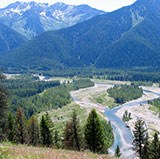
River flood plains are hot spots of biodiversity and productivity due to dynamic interactions between water, sediments, vegetation, and other organisms. Connectivity between surface and ground waters plays an important role in floodplain ecology and habitat diversity, particularly through the exchange of water and materials between the river and the alluvial aquifer that lies just under the surface. This extensive surface and groundwater connectivity also sustains water quantity and quality. Due to human development, floodplains are one of the most endangered ecosystems in the world.
For decades, FLBS researchers have been studying these processes and how they influence organisms at the Nyack Floodplain Research Natural Area on the Middle Fork Flathead River, located between Glacier National Park and the Great Bear Wilderness. This research has demonstrated the vital importance of surface and ground water exchange and has fundamentally molded contemporary river science, management, and conservation.
Currently, FLBS PhD student Amanda DelVecchia is studying how naturally occurring methane gas may subsidize productivity on the flood plain. Amanda is characterizing microbial and invertebrate communities in relation to the environmental gradients of the alluvial aquifer to better understand utilization of methane and organic matter. Her work aims to understand how organisms use, cleanse, and enrich water as it flows through the aquifer, information that is needed to sustain the ecological integrity of rivers around the world. Large stoneflies are iconic players in this story as analyses show that they feed on microbes that use methane as an energy source.
Read more about the Biocomplexity project (link on old site)
- Tockner, K. and J. A. Stanford. 2002. Riverine flood plains: present state and future trends. Environmental Conservation 29(3):308–330.
- Harner, M. J. and J. A. Stanford. 2003. Differences in cottonwood growth between a losing and a gaining reach of an alluvial flood plain. Ecology 84(6):1453–1458.
- Poole, G. C., J. A. Stanford, S. W. Running, C. A. Frissell, W. W. Woessner and B. K. Ellis. 2004. A patch hierarchy approach to modeling surface and subsurface hydrology in complex flood-plain environments. Earth Surface Processes and Landforms 29(10):1259–1284.
- Stanford, J. A., M. S. Lorang and F. R. Hauer. 2005. Plenary lecture: the shifting habitat mosaic of river ecosystems. Verhandlungen Internationale Vereinigung für Theoretische und Angewandte Limnologie 29(1):123–136.
- Whited, D. C., M. S. Lorang, M. J. Harner, F. R. Hauer, J. S. Kimball and J. A. Stanford. 2007. Climate, hydrologic disturbance, and succession: drivers of floodplain pattern. Ecology 88(4):940–953.
- Mouw, J. E. B., J. A. Stanford and P. B. Alaback. 2009. Influences of flooding and hyporheic exchange on floodplain plant richness and productivity. River Research and Applications 25(8):929–945.
- Morris, M. R., B. O. Brouwer, J. K. Caves, M. J. Harner and J. A. Stanford. 2010. Successional changes in soil and hyporheic nitrogen fertility on an alluvial flood plain: implications for riparian vegetation. Aquatic Sciences 72: 519–532.
- Tockner, K., M. S. Lorang and J. A. Stanford. 2010. River floodplains as model ecosystems to test general hydrogeomorphic and ecological concepts. River Research and Applications 26(1): 76–86.
- Helton, A. M., G. C. Poole, R. A. Payn, C. Izurieta and J. A. Stanford. 2014. Relative influences of the river channel, floodplain surface, and alluvial aquifer on simulated hydrologic residence time in a montane river floodplain. Geomorphology 205:17–26.