
Ecological Effects of Dams: Regulated Rivers and the Serial Discontinuity Concept
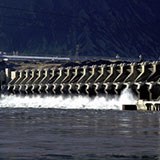
River ecosystems are altered dramatically by the presence of dams and reservoirs. Reservoirs directly convert river habitat into lakes, environments for which most river organisms are not well suited. Dams interrupt the continuity of conditions and transportation of materials in streams and rivers as flow moves downstream.
After the major dam building era in the US, 1940s–1960s, FLBS researchers were among the first to scientifically examine the ecological effects of dams, pioneering the field, writing the first text book, and founding the first journal about Regulated Rivers.
Findings have shown that rivers are changed but can reset or recover from the deleterious impacts of dams in relation to mode of dam operations and distance downstream from the dam. This discovery was formalized into the “Serial Discontinuity Concept” of river ecosystems, which predicts the ecological effects of dam operations and allows water, temperature, and material fluxes to be normalized, thereby ameliorating impacts of river regulation on biota, sediment transport, habitat characteristics, riparian vegetation, and other important attributes of rivers.
FLBS research has helped shape today’s dialogue balancing the ecological costs of dams with their benefits to society. This is particularly important as many dams in the US are currently undergoing re-licensing, a process that determines future dam operations for the next 20-50 years. This process now requires the consideration of ecological effects, which at times has even resulted in the recommendation of dam removal.
- Ward, J. V. and J. A. Stanford. 1979. The Ecology of Regulated Streams. Plenum Press, New York.
- Ward, J. V. and J. A. Stanford. 1983. The serial discontinuity concept of lotic ecosystems, pp. 29–42. IN: Fontaine, T. D. I. and S. M. Bartell (eds.), Dynamics of Lotic Ecosystems. Ann Arbor Science Publishers, Ann Arbor.
- Stanford, J. A. and J. V. Ward. 1983. The effects of mainstream dams on physicochemistry of the Gunnison River, Colorado, pp. 43–56. IN: Adams, V. D. and V. A. Lamarra (eds.), Aquatic Resources Management of the Colorado River Ecosystem. Ann Arbor Sci. Publ., Ann Arbor.
- Stanford, J. A., F. R. Hauer and J. V. Ward. 1988. Serial discontinuity in a large river system. Verh. Internat. Verein. Limnol. 23:1114–1118.
- Stanford, J. A. and F. R. Hauer. 1992. Mitigating the impacts of stream and lake regulation in the Flathead River Catchment, Montana, USA: An ecosystem perspective. Aquatic Conservation: Marine and Freshwater Ecosystems 2(1):35–63.
- Ward, J. V. and J. A. Stanford. 1995. The serial discontinuity concept: extending the model to floodplain rivers. Regulated Rivers: Research and Management 10(2–4):159–168.
- Hauer, F. R. and M. S. Lorang. 2004. River regulation, decline of ecological resources, and potential for restoration in a semi-arid lands river in the western USA. Aquatic Sciences 66:1–14.
- Lorang, M. S. and G. Aggett. 2005. Potential sedimentation impacts related to dam removal: Icicle Creek, Washington, USA. Geomorphology 71:182–201.
- Lorang, M. S., F. R. Hauer, D. C. Whited and P. L. Matson. 2013. Assessing flow releases from a dam to maximize renaturalization of a regulated gravel-bed river using airborne remote sensing imagery. Reviews in Engineering Geology 21:117–132.